How much does a septic system cost in Alabama?
A new conventional septic system in Alabama usually lands between $3,600 and $12,500, with most homeowners paying around $8,000, according to HomeAdvisor’s June 2026 data. Engineered systems for lots with shallow rock or slow clay run $10,000 to $20,000. The real number comes from your soil, your bedroom count, and how deep the rock sits.
Those are market ranges, not our price. Our number comes from looking at the lot. Septic system installation in Piedmont and Northeast Alabama is the core of what we do, and the estimate is free.
What drives septic system cost in Northeast Alabama?
Soil sets the price more than anything else. A lot that drains well takes a conventional gravity system with a modest drain field. A lot with slow red clay or rock close to the surface needs a bigger field, or an engineered design, and the cost climbs from there. Bedroom count, slope, access, and setbacks move it the rest of the way.
Alabama’s onsite sewage rules spell out the line between a normal job and a hard one. Percolation rates from 5 to 120 minutes per inch can take a conventional system. Rates of 121 minutes per inch and slower require an engineered system. Heavy clay that soaks up water slowly is what pushes a lot past that line.
Rock matters too. The state requires 18 inches of soil between the bottom of the drain field trenches and hard rock. On the sandstone and chert ridges around Piedmont, Jacksonville, and Fort Payne, that soil is not always there. The fix is usually a raised or pumped design, which costs more than gravity.
The valleys carry their own rule. Much of Calhoun County sits on limestone and dolomite, and that ground can hold sinkholes. Alabama keeps the drain field 300 feet from any cave, sinkhole, or similar depression. That one setback can shrink the usable part of a lot and force an engineered layout.
Slope adds cost as well. The state calls for an engineer whenever the slope tops 25 percent. Steep hill lots take more digging and more careful trench work.
How much does a septic tank cost by bedroom count?
Alabama sizes the tank by bedrooms, not square footage, and the state table is simpler than most national guides claim. Four or fewer bedrooms need a 1,000 gallon tank. Five bedrooms need 1,500 gallons. Each bedroom after that adds 250 gallons. Cost by bedroom rises because the drain field grows, not because the tank does.
| Bedrooms | Alabama minimum tank | Typical system cost (Fixr, Jan 2025) |
|---|---|---|
| 2 | 1,000 gallons | $1,500 to $3,000 |
| 3 | 1,000 gallons | $3,000 to $7,000 |
| 4 | 1,000 gallons | $7,000 to $12,000 |
| 5 | 1,500 gallons | $12,000 to $20,000 |
The state designs each bedroom at 150 gallons of wastewater per day. A three bedroom house is a 450 gallon per day system. A four bedroom house is 600. That extra 150 gallons has to go somewhere, so the field gets longer.
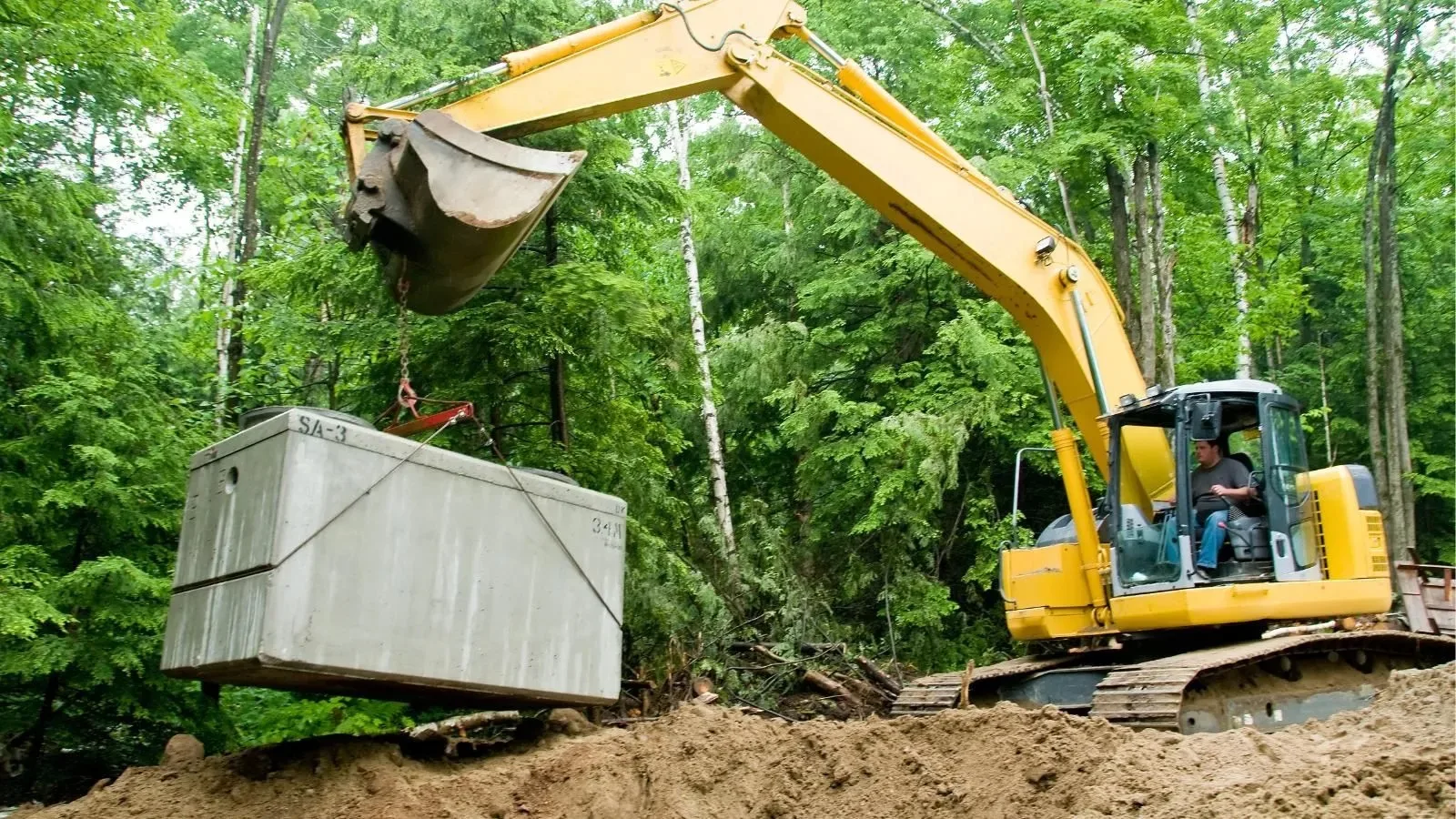
The tank is the cheap part. HomeAdvisor prices a 1,000 gallon tank at $900 to $1,500. Concrete, plastic, and fiberglass all land in a similar band. The drain field runs $5,000 to $12,000 on its own, and excavation adds $1,500 to $6,300.
What does an engineered septic system cost?
Engineered systems run $10,000 to $20,000 in HomeAdvisor’s 2026 data. Mound systems average around $15,000. Aerobic treatment units land at $10,000 to $20,000. Drip distribution runs $8,000 to $18,000. These designs go in when a conventional field cannot work, and a licensed engineer draws the plan.
For a normal house, flow never triggers the engineer. At 150 gallons per bedroom, a home would need 12 bedrooms to reach the state’s 1,800 gallon threshold. Site conditions do the triggering: a perc rate past 120 minutes per inch, rock near the surface, a slope over 25 percent, or a lot smaller than the state minimum.
Lot size is worth checking before anything else. Alabama wants 40,000 square feet for a lot on a private well, or 15,000 square feet on public water. An engineered design can bring the well lot down to 20,000 square feet. The lot also has to hold room for a full replacement field.
We install these systems under an Alabama Level II installer license. Read more about engineered septic systems and what they involve before you price one.
What are the smaller line items?
The soil work comes first and costs less than people expect. Fixr’s 2025 data puts a perc test or soil evaluation at $600 to $800 on average, with a full span of $150 to $2,000 depending on acreage. A licensed engineer, surveyor, geologist, or soil classifier performs the test. We coordinate the perc test and soil evaluation as part of a new build.
An engineered design carries its own fee, usually $600 to $800 for the drawings. Risers add $300 to $600. A distribution box runs $500 to $1,500.
The county application fee is the small part. Published Alabama county health department schedules we found run about $50 to $200, with Elmore, Russell, and Mobile counties as examples. National guides quote permit costs in the thousands, and that number does not match Alabama. Calhoun County does not post its schedule online. Call the Environmental Health Division for the current amount, or ask us when we come out. Our guide to Alabama septic permits and perc tests walks through the process.
How long does a septic system last, and what does replacement cost?
Alabama Cooperative Extension puts the life of a well kept system at 20 to 30 years. The tank often outlasts the field. When only the tank fails, HomeAdvisor prices a tank replacement on an existing field at $3,000 to $10,000. When the field fails, a new drain field runs $5,000 to $12,000.
Most systems do not fail all at once. A soggy patch of yard, slow drains, or a smell over the lines usually means the field is tired. Drain field repair often costs less than a full replacement. Our post on septic tank repair versus replacement covers how to tell which one you need.
How do costs compare across the line in Northwest Georgia?
Georgia prices run close to Alabama. Septic and Well Pro’s June 2026 guide puts a three bedroom conventional gravity system at $6,397 to $7,600. Mound and aerobic systems run $10,000 to $20,000. North Georgia mountain sites reach $10,000 to $25,000, because the same ridge and valley ground continues across the state line.
Georgia adds one cost most Alabama homeowners never see. A certified soil classifier writes a Level III soil report before the county environmental health office issues the permit. That report runs $500 to $1,500. We work Rome, Cedartown, Rockmart, and Summerville, and the permit process there starts with that report.
Getting a real number for your lot
Every range above is a market figure. Your lot sets your price. Soil, rock, slope, bedrooms, and access all move it, and none of them show up on a phone call. We come out, look at the ground, and price the whole job before any digging starts. Request a free estimate or call (256) 453-9003.