What are Alabama’s septic tank permit and perc test requirements?
In Alabama nobody may install, repair, or replace a septic system until the county health department issues a Permit to Install. A licensed soil professional evaluates the lot first, the health department reviews the application and visits the site, and then the permit issues. The department has 28 days to act, and the permit is good for five years.
The perc test most people ask about is one of four site evaluation methods the state accepts. Whichever method is used, the installer has to be licensed by the Alabama Onsite Wastewater Board, nothing may be covered until the health department has had a chance to inspect it, and the system may not be used until an Approval for Use is issued. We coordinate the perc test and site evaluation for every new build, and the estimate is free.
How does the Alabama septic permit process work?
The process runs in a fixed order, and the order matters. First, a licensed engineer, land surveyor, geologist, or professional soil classifier evaluates the site. Second, the owner files ADPH Form CEP-2 with the county health department, with the soil findings on Part C. Third, the department reviews the application, visits the lot, and issues the Permit to Install. Only then can anyone dig.
The state puts a clock on the county. The health department has to issue the permit or say why not within 28 calendar days of a complete application. An incomplete application gets another 30 days before it expires. Once issued, a Permit to Install is valid for five years.
After the system goes in, the installer schedules an inspection with the county’s environmentalist and confirms it by 9 a.m. that day. Nothing gets covered before that visit. The installer files Form CEP-5 within three business days, and the health department issues the Approval for Use. That document is what a lender or buyer will ask for years later.
Every lot also has to reserve room for a full replacement drain field. If the first field ever fails, the second area is already mapped. That reserve is why lot size rules exist.
What is a perc test and what does Alabama require?
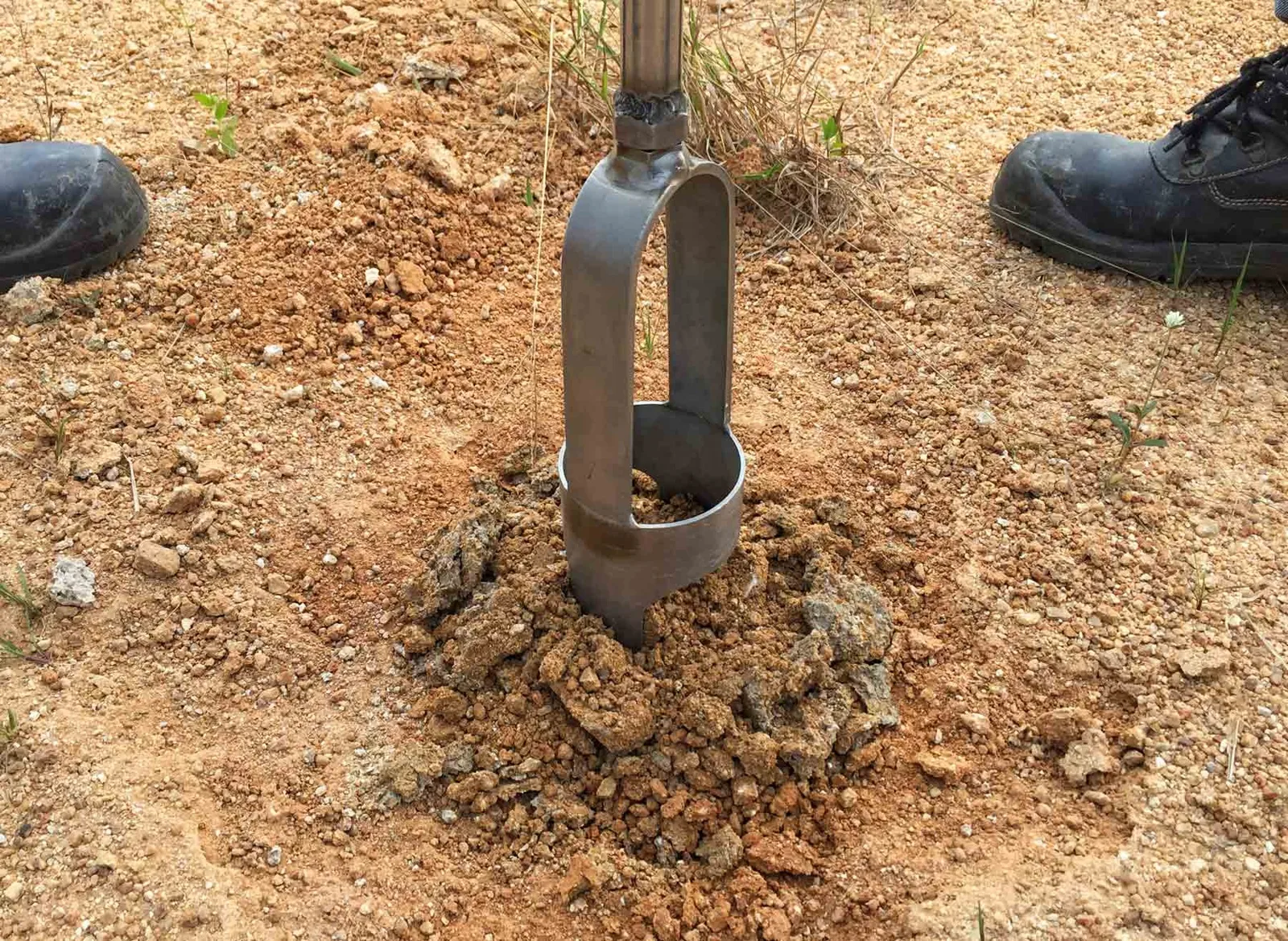
A percolation test measures how fast water drops in a hole dug at the depth of the future drain field. Alabama reports the result in minutes per inch. For a single family home the rule requires at least two tests in the drain field area, at least 30 feet apart, plus one in the replacement field on lots under 15,000 square feet.
The method is spelled out in the rule. The hole is 4 to 8 inches across and at least 12 inches deep. The walls are roughed up to remove glazing. The tester fills it with at least 12 inches of clear water and lets it soak for at least four hours, preferably overnight. Readings start within eight hours of that soak, with the water reset to six inches over the bottom and measured every 30 minutes for four hours, until three readings match within an eighth of an inch.
Heavy clay gets a longer test. Soils with a high shrink swell rating need 24 hours of constant saturation before the reading starts. That is a scheduling fact on the red clay lots around Anniston, Oxford, and Gadsden. So is the calendar. The rule defines Alabama’s wet season as December 1 through April 30, and a lot that percs in September can show seasonal saturation in February.
A perc test is not the only path. The rule also accepts soil mapping, soil morphology, and the unified system. A soil classifier reading a pit is often the faster route on a lot with obvious clay or rock. The evaluator rates six factors: permeability, depth to seasonal saturation, depth to bedrock or another restrictive layer, slope and landform, flooding, and surface saturation. The most limiting factor decides whether the lot can take a conventional system, an engineered system, or neither.
What perc rate passes for a conventional system?
Alabama’s Table 7 sets the classes. Rates from 5 to 120 minutes per inch can take a conventional gravity system. Rates of 121 minutes per inch and slower are rated extreme and require an engineered design. The very fast end, under 5 minutes per inch, is rated severe and still conventional, but it needs a deeper separation from groundwater.
| Percolation rate (minutes per inch) | Site rating | System type |
|---|---|---|
| 5 to 30 | Slight | Conventional |
| 31 to 90 | Moderate | Conventional |
| 91 to 120 | Severe | Conventional |
| 121 to 240 | Extreme | Engineered |
| Slower than 240 | Extreme | Engineered |
Perc rate is one gate. Rock is another. The bottom of a conventional trench has to sit at least 18 inches above hard bedrock, and any layer with more than half consolidated rock counts as a restrictive layer. On the sandstone and chert ridges around Piedmont and Fort Payne, that 18 inches is not always there. Slope is a third gate: a drain field area steeper than 25 percent requires an engineer.
Setbacks shrink the usable ground further. The drain field must sit 100 feet from a well or spring, 50 feet from surface water, and 300 feet from a cave, sinkhole, or similar depression. That last one matters in the limestone valleys of Calhoun and Etowah counties. A geologist can reduce it with a written study, but never below 60 percent.
Then the lot itself has to be big enough. For lots recorded since March 2006, the minimum is 40,000 square feet on a private well and 15,000 square feet on public water. An engineered design can bring the well lot down to 20,000 square feet. A lot whose field sits in hydric or high shrink swell soil needs a full acre. When a lot fails one of these gates, the answer is usually an engineered septic system, not a denial.
Can you install your own septic system in Alabama?
Only for your own house, and only if you do all of it. Alabama’s licensing law exempts a property owner installing, cleaning, or maintaining a system on their own one or two family primary residence, as long as they complete every bit of the work themselves without help. Hire or pay anyone to help and the exemption is gone.
The exemption does not touch the permit. The Permit to Install still comes first, the tank still has to meet the sizing table, the setbacks still apply, and the health department still inspects before cover. Everyone else who installs, repairs, or maintains a system in Alabama has to hold a license from the Alabama Onsite Wastewater Board.
The board issues three installer levels. A Basic installer handles conventional systems up to 1,800 gallons per day. Advanced Level I adds mound systems and time dosed pumps. Advanced Level II covers every system, including large flow and advanced technology designs. Jim Westbrook holds the Alabama Level II installer license, which is why septic system installation here covers engineered and commercial work, not just gravity systems.
How much does a septic permit cost in Alabama?
There is no statewide fee. The rule says only that the health department may assess a fee where it has authority, and each county sets its own. Calhoun, Etowah, DeKalb, and Talladega counties do not publish their schedules online. Call the county environmental health office for the current amount, or ask us when we come out. For scale, Mobile County, one of the few that posts a schedule, charges $200 for a residential application and inspection.
The bigger cost is the soil work. Fixr’s January 2025 data puts a perc test or soil evaluation at $600 to $800 on average, with a full span of $150 to $2,000 depending on acreage and the number of holes. An engineered design adds its own fee. Our cost guide for a new septic system in Alabama puts those pieces next to the full install price.
What about septic permits in Northwest Georgia?
Georgia runs the same idea through different rules. The county board of health issues a construction permit before any lot development or system work. The board has 20 days to approve or deny a complete application, and the permit is valid for no more than 12 months. A certified soil classifier writes the soil report first, and the classifier, engineer, or geologist has to carry a million dollar liability policy.
Georgia also publishes its fees, which Alabama’s counties do not. The Northwest Georgia Health District posts schedules showing a septic application and site visit at $275 in Floyd County and $250 in Polk and Chattooga counties, with an existing system evaluation at $125, $100, and $125. Those schedules carry 2008 and 2009 effective dates, so confirm the current number with the county office before you budget.
Repairs are stricter across the line. Georgia requires repairs, replacements, and additions to existing systems to be permitted and inspected, with no maintenance carve out. And Georgia triggers an existing system evaluation in more situations, including loan closings, refinancing, additions, pools, and mobile home moves.
Does Alabama require a septic inspection when you sell?
No. There is no statewide point of sale inspection rule in Alabama. The health department evaluates an existing system when the owner or the lender asks, and the evaluation carries no guarantee the system will keep working. Before that evaluation, the owner has to show the tank was pumped within the last three years by a licensed pumper. A system installed without a permit on or after March 18, 1982 may be turned down until it meets current rules.
A home inspector’s septic check is not the same thing and does not carry the rule’s authority. If you are buying or selling on septic in Northeast Alabama, a septic inspection that opens the tank and walks the field is the one that tells you what you are getting. Our guide on septic tank repair versus replacement covers what to do with the findings.
Where to start
Start with the soil, not the tank. Get the site evaluation done, file the CEP-2 with the county, and let the permit set the design. We handle that order every week for new builds and replacements across Northeast Alabama and Northwest Georgia. Request a free estimate or call (256) 453-9003.