How often should a septic tank be pumped in Alabama?
The Alabama Department of Public Health says to have a licensed technician clean your septic tank and effluent filter every three to five years, with an inspection every year. EPA gives the same interval, plus an inspection at least every three years. The real schedule depends on tank size and how many people live in the house.
Those are guidance numbers, not a law. No Alabama rule sets a pumping deadline for a homeowner. The one hard date is tied to selling: before a county health department evaluates an existing system, the owner or lender has to show the tank was pumped within the last three years by a licensed pumper. Routine septic tank pumping in Piedmont and Northeast Alabama is one of the services we run, and the estimate is free.
How does household size change the pumping schedule?
Tank size and people set the interval. A tank fills with solids at a rate tied to how many people use it. ADPH publishes a table built on the same 1984 engineering study every state uses, and it shows how wide the spread is. One person on a 1,000 gallon tank can go about 12 years. Eight people on the same tank are pumping every year.
| Tank size | 1 person | 2 people | 4 people | 6 people | 8 people |
|---|---|---|---|---|---|
| 1,000 gallons | 12 years | 6 years | 3 years | 2 years | 1 year |
| 1,250 gallons | 16 years | 8 years | 3 years | 2 years | 1 year |
| 1,500 gallons | 19 years | 9 years | 4 years | 3 years | 2 years |
Those figures are ADPH’s suggested pumping frequencies, rounded to whole years. Most homes in Calhoun, Etowah, and Talladega counties sit on a 1,000 gallon tank, because Alabama allows that size up to four bedrooms. A family of four on that tank is on a three year cycle, not five.
A garbage disposal moves every number down. ADPH says a disposal adds about 50 percent more solids to the tank. Extension guidance moves the inspection from every three years to every year when a disposal is in use.
What are the signs a septic tank is full?
A full tank announces itself through the house and the yard. EPA lists wastewater backing up into drains, slow tubs and showers, gurgling in the plumbing, standing water or damp spots over the tank or drain field, sewage odors, and bright green, spongy grass over the field even in dry weather. ADPH flags the same symptoms for Alabama homes.
Inside the tank there is a measurable answer. EPA’s rule is to pump when the bottom of the scum layer sits within six inches of the outlet, when the top of the sludge is within 12 inches of the outlet, or when sludge and scum take up more than a quarter of the liquid depth. A pumper measures those layers on every visit, and that reading tells you when the next one is due.
Do not wait for the yard to tell you. By the time effluent surfaces over the field, solids have usually been washing out of the tank for a while. That is how a pumping problem turns into drain field repair.
How much does it cost to pump a septic tank?
EPA puts routine maintenance at $250 to $500 every three to five years. This Old House’s May 2026 survey found a $420 national average, with a typical range of $290 to $560. Today’s Homeowner reports the same size based table. We could not find a verified Alabama only figure, so treat these as market ranges, not our price.
| Tank size | Typical pump out cost (This Old House, May 2026) |
|---|---|
| 750 gallons | $175 to $300 |
| 1,000 gallons | $225 to $400 |
| 1,250 gallons | $275 to $500 |
| 1,500 gallons | $345 to $600 |
| 1,750 gallons | $400 to $700 |
Two things push the bill up. A buried lid the pumper has to dig for adds $50 to $200. Hardened sludge that has been sitting for years adds $100 to $300. ADPH’s own advice cuts the first one: a watertight riser brought up to grade helps you find the tank and may reduce the pumping fee. Riser work is part of septic tank maintenance.
What does the pumper actually do?
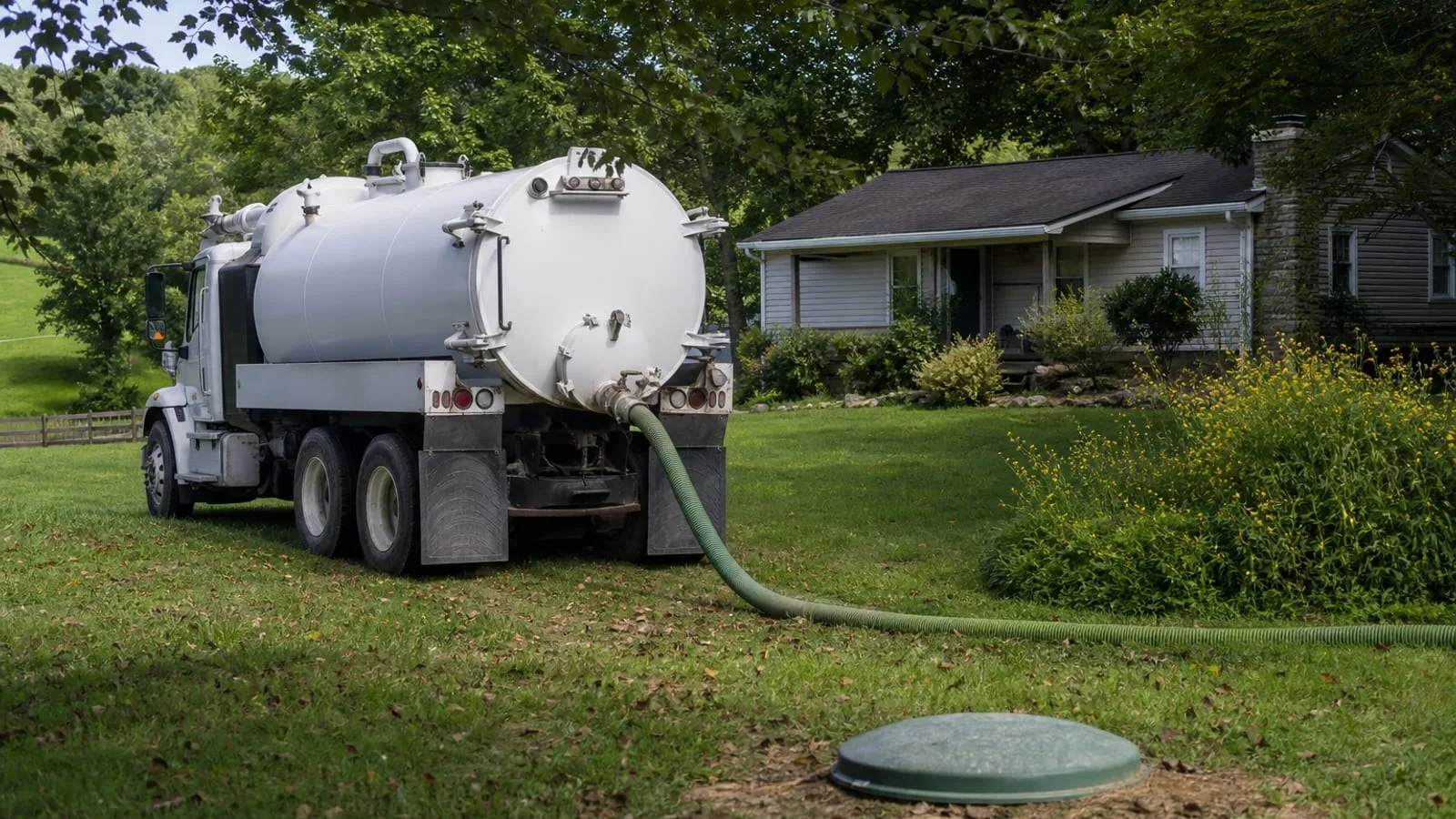
A pump out is more than draining the tank. The pumper opens the tank through the main access ports, not the small inspection ports, and pumps both compartments after mixing the solids. EPA says the service provider should check for leaks, measure the scum and sludge layers, and note the tank’s condition and any repairs on the service report. Virginia Tech’s guidance adds two things to ask for: a look at the baffles and a check for roots.
Alabama adds a paper trail. State rules require a sewage tank pumper to keep a record of every job for three years, including the tank size and the gallons removed. Ask for that record. It tells you your tank size, which is the first number you need to set your own interval.
Pumpers in Alabama are licensed by the Alabama Onsite Wastewater Board, and the county health department permits and inspects the pump trucks. You can check any license at the state’s public lookup.
Do septic tank additives replace pumping?
No. EPA’s homeowner guide says periodic pumping is the only true way to keep a septic system working, and that additives show no significant effect on the bacteria in a tank. ADPH goes further and warns that additives can re-suspend solids and clog your drain field. Georgia’s health department manual says the same thing for the other side of the state line. Save the money for the pump out.
Why a full tank hurts more in Northeast Alabama
The ground around Piedmont, Anniston, and Gadsden leaves a drain field little margin. The valleys carry red clay that holds water. The ridges carry cherty, gravelly soil with rock close to the surface. Alabama Cooperative Extension names both as problem soils for septic: too much clay holds water and stops the flow, and shallow rock leaves no room for treatment.
A tank that runs too long pushes solids into that field. In clay, the solids seal the trench walls. Over rock, there is no depth to absorb the extra load. Either way the field fails years early, and a field costs far more than a pump out. The state’s own wet season, December through April, saturates these soils and makes the timing worse. Extension’s advice for those months is simple: use less water and keep roof drainage off the field.
If the yard is already showing wet spots, a pump out alone will not fix it. We look at the tank and the field together. Our guide on septic tank repair versus replacement covers what happens next, and the cost guide for a new system in Alabama covers the worst case.
Setting your schedule
Find your tank size on the county permit, or ask your last pumper for the record. Count the people in the house. Read the table. Then mark the next pump out on the calendar and keep the receipt, because the day you sell, the health department will ask for it. If the last pump out was more than three years ago, or nobody remembers, call (256) 453-9003 or request a free estimate.