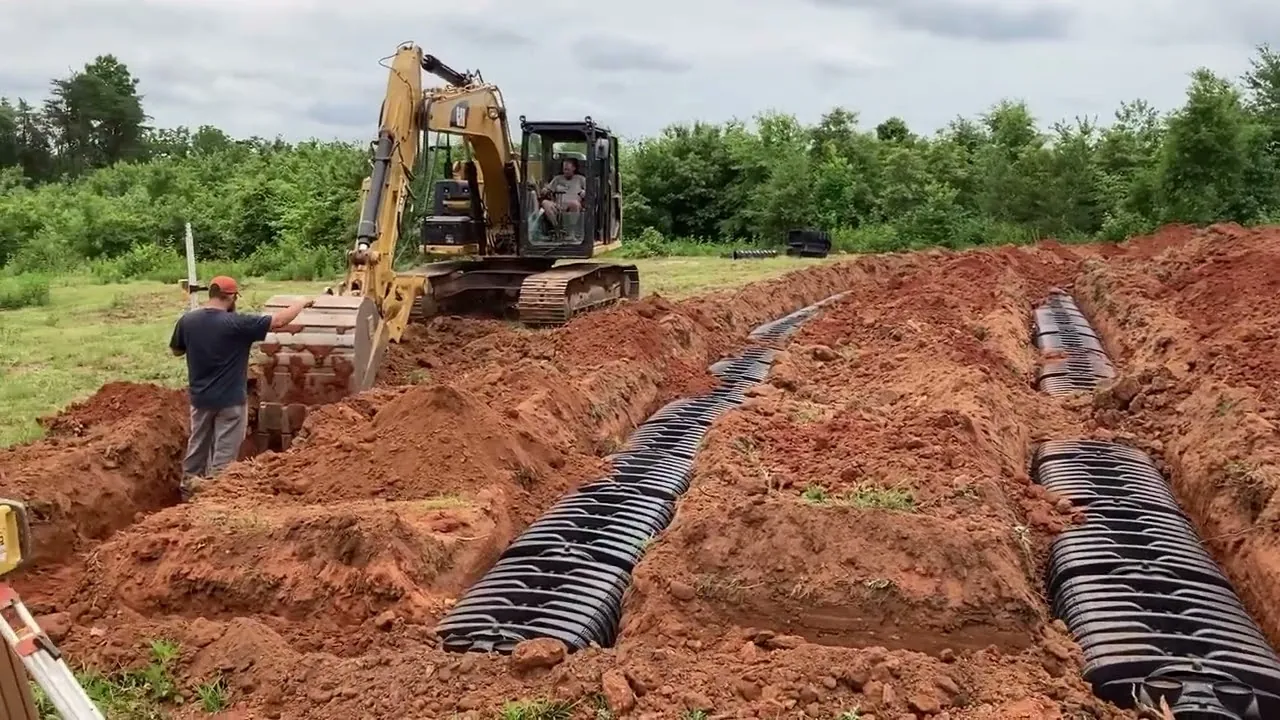
Chamber vs gravel drain field: which one fits your lot in Alabama?
Your soil tests and the county permit decide which drain field your lot gets. Alabama allows both a gravel trench and a chamber field under a county permit, and their costs overlap. The Septic Guide’s March 2026 drain field guide puts gravel at $3,000 to $10,000 and chambers at $4,000 to $12,000.
Drain field, leach field and field lines all name the same buried trenches past the tank. Both types send the water from the tank into the soil, where microbes finish the treatment. We handle drain field installation across Northeast Alabama from our base in Piedmont, and every estimate is free.
What is a gravel drain field?
The U.S. Environmental Protection Agency (EPA) calls the gravel and stone drain field a design that has existed for decades. Water from the septic tank is piped to a shallow underground trench of stone or gravel. It filters through the stone, and microbes treat it further once it reaches the soil below.
In Alabama, the gravel trench is the Gravel Field Standard in the state’s onsite sewage rules, Chapter 420-3-1. Rule .58 carries the title Gravel Field Standard Construction Specifications. It sets out how the trench is built:
- The trench is 18 to 36 inches wide and at least 12 inches deep.
- The stone is washed and clean, free of fines, dust, sand and clay.
- The stone runs one-fourth inch to 2.5 inches in size.
- The stone reaches at least 8 inches below the pipe.
- The perforated pipe goes in with the holes turned down. Agricultural drainpipe with slits is not approved.
- Untreated building paper, heavy Kraft paper or geotechnical fabric covers the stone.
- At least 12 inches of earth goes over the field.
- Plastic sheeting is never used as the cover over the stone.
EPA explains the reason for that cover layer. It keeps sand, dirt and other contaminants out of the clean stone. EPA also says gravel and stone systems are relatively large in overall footprint and may not suit every site.
What is a chamber drain field?
A chamber field is a gravelless drain field. The Septic Guide says chamber systems use connected plastic chambers in place of gravel-filled trenches. EPA describes the same layout: a series of connected chambers, with soil filled in around and above them.
In a chamber septic system, pipes carry wastewater from the septic tank to the chambers. Inside the chambers, EPA says, the wastewater comes into contact with the soil. Microbes on or near the soil treat it. So in both designs, the soil and its microbes do the treating.
In Alabama, plastic septic chambers count as a permitted disposal product. The Alabama Department of Public Health (ADPH) issues Product Permits to the makers of proprietary disposal products. Each permit sets conditions for design, installation and maintenance, and the maker, designers, installers and users must follow them.
EPA says gravelless fields have been widely used for over 30 years in many states. It lists several forms, including open-bottom chambers, fabric-wrapped pipe and synthetic media. In Alabama, any aggregate other than washed stone needs a Product Permit as well.
How does Alabama size a chamber field compared to gravel?
Both types start from the same number. Rule 420-3-1-.53 makes the Gravel Field Standard the minimum total trench bottom area for a home. That area is the bedroom count times the square feet per bedroom in the state’s sizing tables.
Soil sets the rest. The rule ties the loading rate, or how much water each square foot may take, to the lot’s perc rate. The Septic Guide’s drain field guide says poor percolation in clay or hardpan means a larger field. A home’s primary field must be at least 300 square feet of the Gravel Field Standard.
The same rule lets a home use permitted disposal products, such as chambers, with appropriate sizing. Rule .54 says any reduction from the Gravel Field Standard for a permitted product is a percent of bottom area. That percent is written into the product’s ADPH Product Permit. So the product’s own permit sets any size reduction for a chamber field.
Gravel has a reduction option of its own. With a perc rate under 120 minutes per inch, the Gravel Field Standard area may drop by 33 percent. That cut needs 24 inches of total gravel depth.
Only one bottom area reduction may be taken per field. In the rule’s example, a field with an advanced treatment reduction cannot take one for the disposal technology. In the same way, a chamber field cannot add the deeper gravel cut on top of a product reduction.
Where does each type fit best?
The Septic Guide’s drain field guide says your soil conditions determine the field type. It matches a conventional gravel trench to good soil, adequate space and a passing perc test. It matches a chamber system to a high water table or areas where gravel is expensive. The same table lists a high water table for mound systems too, so the soil tests decide.
EPA names increased ease of delivery and construction as the chamber system’s primary advantage. The Septic Guide says chambers are easier to install because no gravel is hauled. EPA adds that chambers suit high groundwater tables and areas where gravel is scarce. It also points to homes where water use varies, such as a vacation home.
Alabama’s rule adds a depth difference for shallow fields. Shallow placement of a field may be used to overcome soil and site limitations. In a shallow trench, gravel goes at least 12 inches into the natural ground. For other permitted products, the Product Permit shows the minimum depth.
A wet lot is still a soil question first. Trench depth has to meet the state’s minimum vertical separation. That is the required gap between the field bottom and a restrictive layer. If water runs onto the field from uphill, a curtain drain above the field can cut it off.
Some lots take neither type. The Septic Guide lists shallow soil and high bedrock among the mound conditions. In Alabama, a drain field site over 25 percent slope needs an engineer design. Those lots need an engineered septic system.
How much does a chamber drain field cost compared to gravel?
The Septic Guide prices both types in two March 2026 cost guides. Its drain field guide prices the field alone. Its installation guide prices a whole new system, tank and field together, by type.
| Field type | Where The Septic Guide says it fits | Published range | Cost guide |
|---|---|---|---|
| Conventional gravel trench, field only | Good soil, adequate space, a passing perc test | $3,000 to $10,000 | The Septic Guide drain field guide, March 2026 |
| Chamber system, field only | A high water table, or areas where gravel is expensive | $4,000 to $12,000 | The Septic Guide drain field guide, March 2026 |
| Conventional gravity-fed system, tank and field | Suitable soil, adequate space, a low water table | $3,000 to $8,000 | The Septic Guide installation guide, March 2026 |
| Chamber system, tank and field | A high water table, or sites where gravel is expensive | $5,000 to $12,000 | The Septic Guide installation guide, March 2026 |
In both of The Septic Guide’s March 2026 guides, the chamber range starts and ends higher than the conventional one. The ranges overlap in the middle. The installation guide points chambers at lots with good soil where gravel is expensive or unavailable locally.
Gravel is one part of a conventional field’s price. The Septic Guide’s March 2026 installation guide puts a conventional system’s drain field line item at $2,000 to $5,000. That line covers trenching, gravel, perforated pipe and the distribution box.
These are published market ranges, never our price. Soil, bedroom count and access to the lot set the real number. For what a whole system runs, see our Alabama septic system cost guide. A new home gets its field as part of septic system installation, with the tank set in the same job.
What stays the same with either type?
The paperwork and the inspection do not change with the field type. No installation or repair begins until the county health department issues a Permit to Install (Repair). Before that permit issues, the soil professional certifies the soil tests.
A licensed soil professional or the county does the soil evaluation, and we coordinate it. We handle the permit with the county health department. Our guide to Alabama septic permits and perc tests explains each step.
Then comes the inspection. No part may be covered or used until the county health department has had the chance to inspect it. Any needed corrections come first, and anything covered too early is uncovered when the department says so. The system is not used until the department issues an Approval for Use.
ADPH says the installer must be licensed by the Alabama Onsite Wastewater Board (AOWB). The company holds the Alabama Level II (advanced) onsite wastewater installer license. That state level covers engineered and large commercial onsite systems as well as conventional ones.
What if your current drain field is failing?
A field that is failing now starts with a different question: repair or replace. Our drain field repair page covers the fixes we make on existing field lines. For the price side, read what drain field replacement costs in Alabama.
How do you find out which field fits your lot?
Every range above comes from a published cost guide, and your own lot sets your price. Our three crews dig field line trenches with the company’s own excavation equipment. Decades of septic installs sit behind the company.
We look at the site and quote the job for free. Call (256) 453-9003 or request a free estimate.